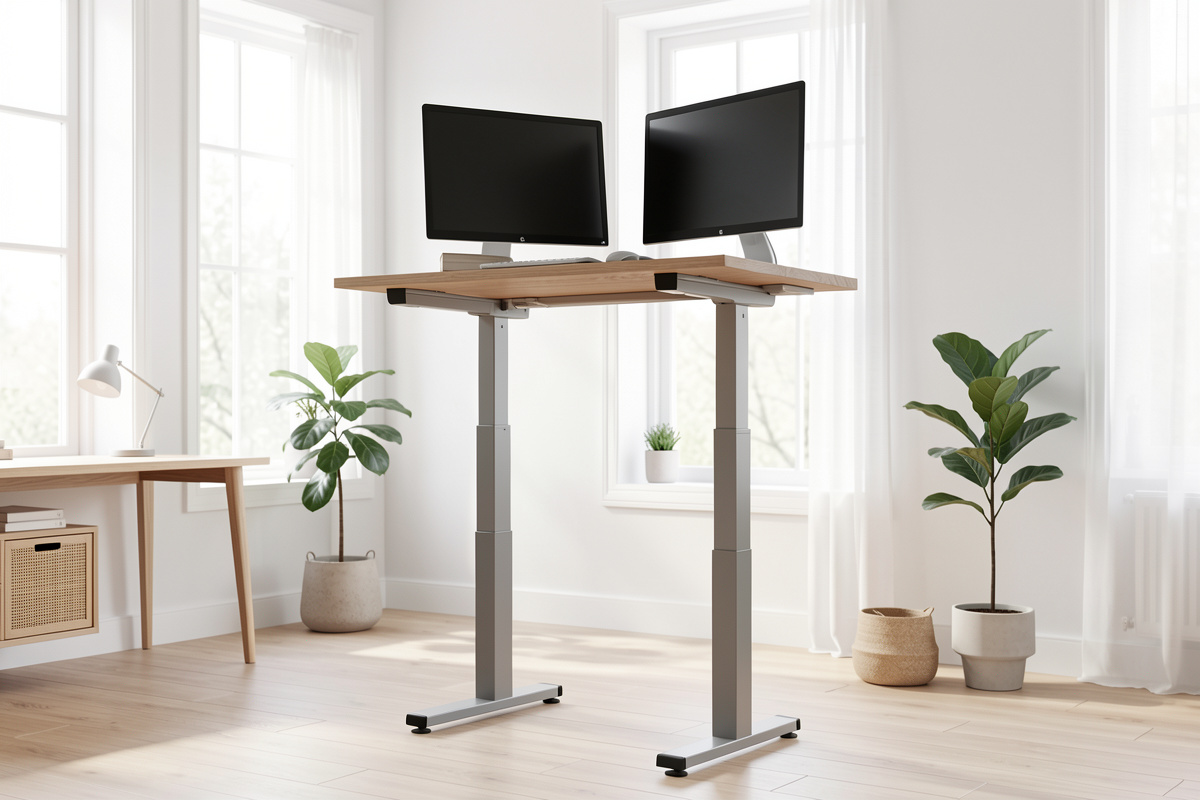

Standing desk wobble at height is the complaint that catches almost everyone off guard, because a desk that feels like a tank at sitting height can turn into a wobbling card table the moment you raise it to stand. That’s not a fluke and it’s not always a defect — it’s the predictable physics of a telescoping frame, and once you understand it you can predict which frames will wobble before you buy and fix most of the wobble on the one you already own. I’ve load-tested my own frames at full extension with the same monitor array every time, so this is the measured version of why height changes everything.
The usual framing first: this is a comfort, fatigue, and geometry article, not a medical one. I’m describing how a steel structure behaves under load as it extends — sway, settling, stiffness — measurable mechanical behaviour, no health claims.
Why height makes a stable desk wobble
Picture the frame as two telescoping legs holding a tray. At sitting height the legs are short and the nested sections overlap deeply, so the structure is stiff. Raise it, and the legs extend: each section slides further out, the overlap between sections shrinks, and the leverage on any flex gets longer. A tiny amount of play down low becomes visible sway up high, multiplied by the longer lever arm. That’s why every standing desk in the world is more stable seated than standing — the question is never whether it wobbles less when raised, it’s how much it wobbles at the height you’ll actually stand at.
How I keep this site running: a couple of links below go to Amazon, and as an Amazon Associate I earn from qualifying purchases. No cost to you, only gear I’d use myself, and everything here is comfort-and-geometry guidance, not medical advice.
The three things that decide stability at height
Leg stages: the single biggest factor
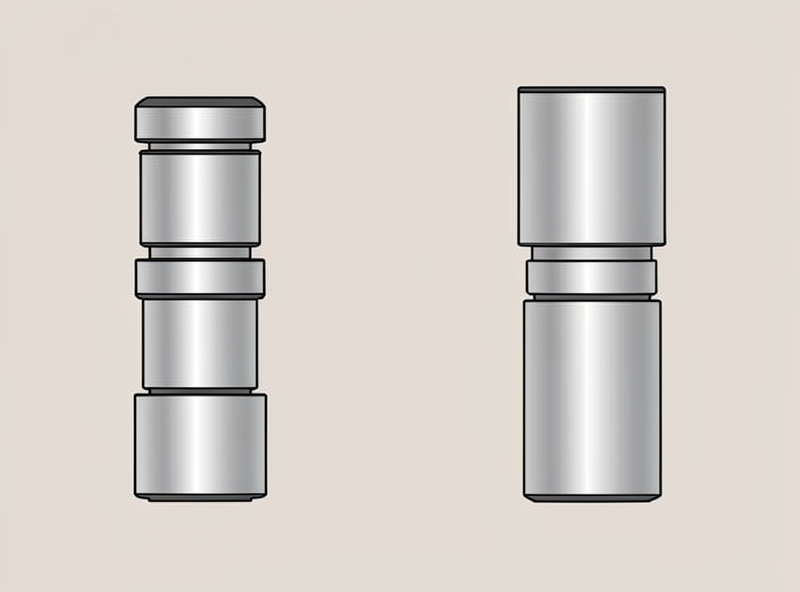
A three-stage leg telescopes into three nested sections; a two-stage into two. More stages means each section is shorter and the overlap at any given height is greater, which is exactly what keeps a leg stiff when extended. This is the dominant predictor of stability at full height — far more than brand, far more than weight rating. If you stand tall, a three-stage frame is not a luxury, it’s the difference between a frame that holds and one that sways. The wobbly bargains are almost always two-stage.
Crossbar or no crossbar
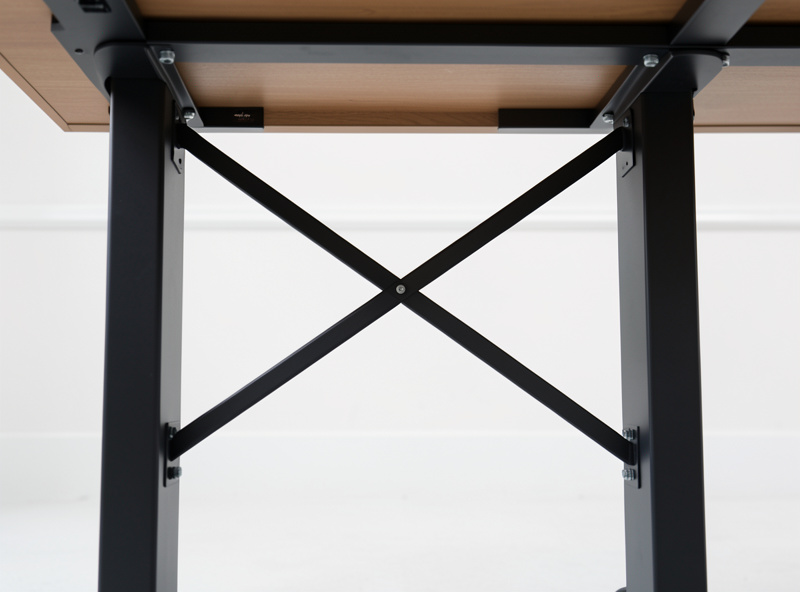
A crossbar ties the two legs together low down, adding rigidity at the cost of legroom and the ability to put a footrest under the desk. Crossbar-free frames look cleaner and free up the space beneath, but they lean entirely on leg quality to stay stiff — a good crossbar-free frame is excellent, a cheap one wobbles. If you’re choosing a crossbar-free frame, the leg stages matter even more.
The top and the load, which people forget
The frame only stabilises the span between its legs. A big top hanging far past the legs flexes at its unsupported edges — that reads as wobble but it’s the top, not the frame. And a heavy, off-centre load at full extension is the worst case for any leg. Centre your weight, keep your top sensibly sized for the leg span, and you remove a surprising amount of perceived wobble without touching the frame.
How to measure wobble instead of guessing at it
“Wobbly” is a feeling; I prefer a repeatable test. Raise the desk to your full standing height, load it the way you actually work, then put both hands flat on the front edge and push firmly fore-and-aft and side-to-side. Watch how far the top moves and — the important part — how long it takes to stop. A solid frame moves a controlled amount and settles instantly. A wobbly frame keeps oscillating after you let go. The settling time is the honest measure, because two frames can move the same distance but the one that keeps swinging is the one that’ll bother you all day. Run this at full height, never at a comfortable middle, because the middle lies.
| Stability factor | More stable at height | Less stable at height |
|---|---|---|
| Leg stages | Three-stage | Two-stage |
| Motors | Dual | Single |
| Bracing | Crossbar, or premium crossbar-free | Cheap crossbar-free |
| Top size vs leg span | Matched, rigid top | Oversized, thin top |
| Load placement | Centred, well under rating | Heavy, off-centre, near max height |
Fixing wobble on a desk you already own
Before you blame the frame, work the checklist. First, re-torque every bolt in a cross pattern — loose assembly is the number-one cause of wobble that looks like a frame defect, and a frame settles in its first week so it’s worth a second pass. Second, check your floor: an uneven or springy floor amplifies every frame’s sway, and adjustable leveling feet to kill a rocking leg do more than any gadget marketed as an anti-wobble cure. Third, centre your heaviest weight over the frame and make sure your top isn’t overhanging absurdly. Do all three before you spend money on brackets — most “wobble fixes” sold online are solving a problem that a hex key and a level already fix.
If you genuinely have a two-stage frame at the top of its travel and you’re tall, no accessory will fully fix it — that’s a buying decision you’ll make differently next time. But for the vast majority of “my standing desk wobbles” cases, the cause is loose bolts, an uneven floor, or an oversized top, and all three are free to address.
The tall-user problem nobody warns you about
If you’re tall, stability at height is a different conversation, and it’s the one most reviews skip because most reviewers are average height. A tall person stands at the very top of a frame’s travel — exactly where the legs have the least overlap and the most leverage on any flex. A frame that’s perfectly stable for a 175 cm user standing at the middle of its range can feel like a different machine for a 195 cm user pinned at its ceiling. This is why two people can review the same desk and disagree completely: they’re standing at opposite ends of the travel.
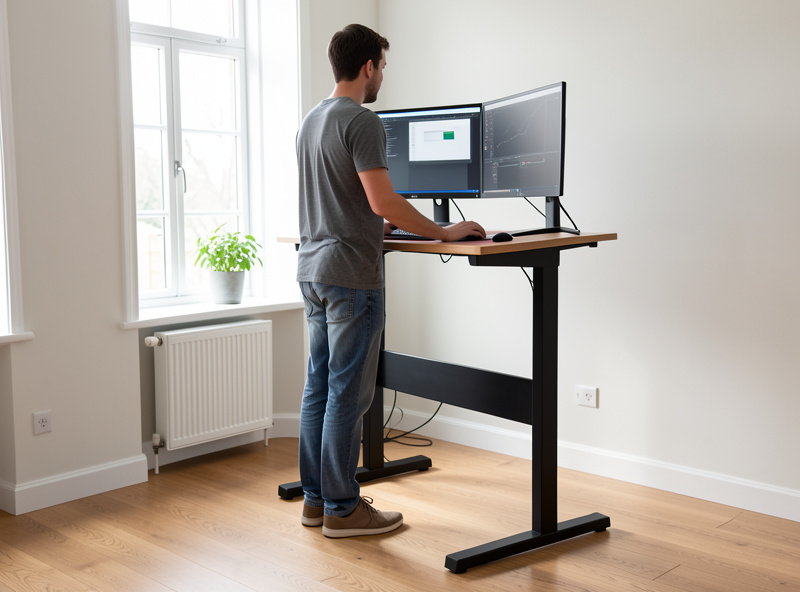
The fix is to buy with margin. Don’t pick a frame whose maximum height barely clears your standing elbow with your top on — pick one with headroom, so your standing height sits comfortably within the range rather than at its absolute limit. A frame standing at 90% of its travel is dramatically stiffer than the same frame maxed out. Headroom in the height range is, in effect, headroom in stability, and it’s the cheapest insurance against wobble a tall buyer can get. Combine that with three-stage legs and you’ve solved the problem before it starts.
How to buy for stability at height
If you’re still shopping, filter in this order: three-stage legs first, dual motors second, then check the frame reaches your standing elbow height with your top on. Read the weight rating as a ceiling you stay well under, not a target. And if you can try it in person, raise the display model to its tallest setting and run the push test — ignore entirely how it feels at sitting height, because that tells you nothing about how you’ll stand at it. A frame that stops dead when nudged at full height is the one worth buying. While you’re optimising the standing experience, a dense anti-fatigue standing mat is the comfort accessory I’d never skip — it won’t change the wobble, but it’s what keeps you actually using the standing range. Pair the frame work with the right seating for the times you sit — the ergonomic chair guide covers how to match a chair to your body so the seated portion of your day is as dialled in as the standing portion.
Why does my standing desk wobble only when raised?
Because a telescoping frame is stiffest when its legs are short and overlapping. Raising it extends the sections, shrinks the overlap, and lengthens the lever arm on any flex, so small play down low becomes visible sway up high. Every frame is more stable seated.
What is the biggest factor in standing desk stability at height?
Leg stages. Three-stage legs keep more overlap between sections when extended, so they stay far stiffer at full height than two-stage legs. It matters more than brand or weight rating, especially for tall users who stand near the top of the range.
How do I test how wobbly a standing desk is?
Raise it to full standing height, load it normally, then push the front edge firmly fore-and-aft and side-to-side. Watch how far it moves and how long it takes to settle. A solid frame stops dead; a wobbly one keeps oscillating after you let go.
Can I fix standing desk wobble without buying a new desk?
Usually yes. Re-torque every bolt in a cross pattern, level any rocking leg on an uneven floor, centre your heaviest weight over the frame, and avoid an oversized overhanging top. Those three free steps fix most wobble that looks like a frame defect.
Does a crossbar make a standing desk more stable?
Yes, a crossbar ties the legs together and adds rigidity, at the cost of legroom. Crossbar-free frames can be just as stable but only if the legs are high quality. A cheap crossbar-free frame relies on legs that often are not up to it.
