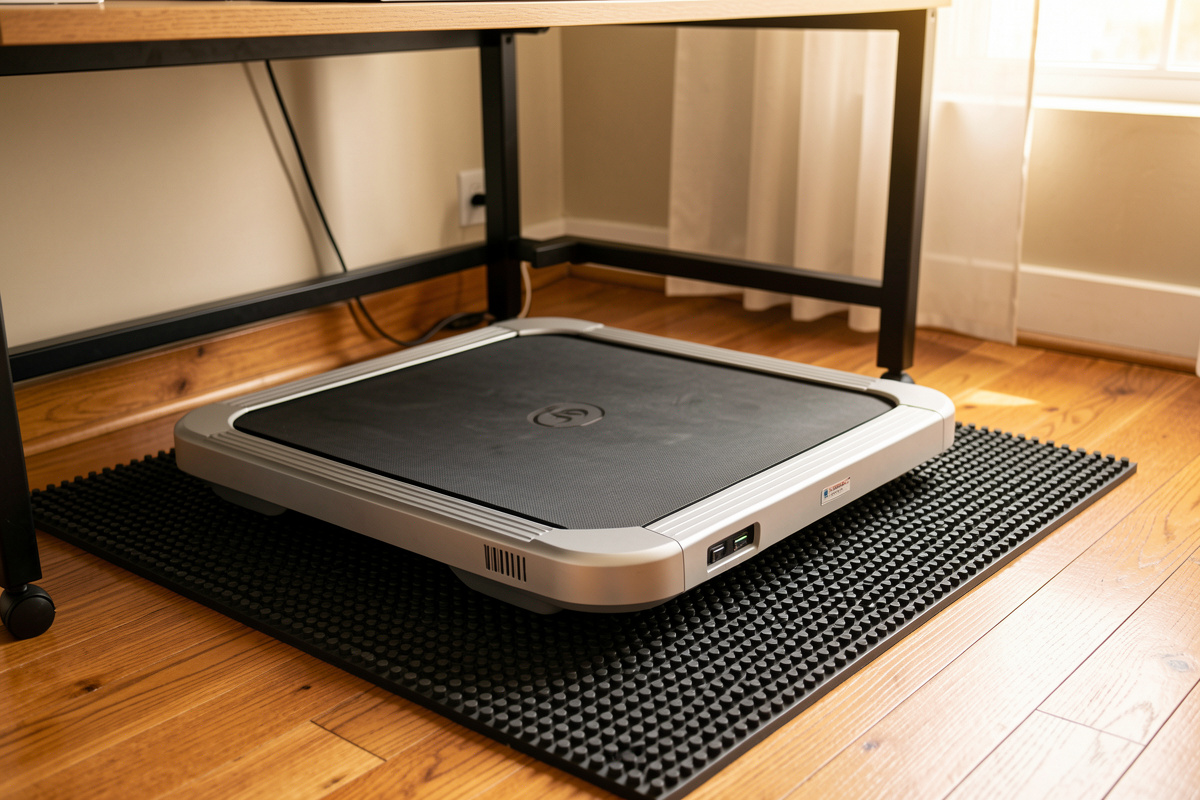

A walking desk needs a dense, high-density mat under the deck — not soft foam — to do two jobs at once: protect the floor from the 25-32 kg deck’s point-load dents and decouple the low-frequency vibration that otherwise travels through the structure to the room below. A firm rubber mat in the 6-12 mm range is the sweet spot. The mat is not an accessory you add later; on hardwood and in apartments especially, it is part of the build, and the wrong mat is worse than none.
I treat the floor layer the way I treat every contact point in a setup — measured, deliberate, and chosen for the load it actually carries. A moving person on a small deck is a different load than a static standing desk, and it asks different things of the floor underneath. This is the floor-protection layer of my treadmill desk guide, covering what the mat does, why density beats softness, and the apartment problem most buyers underestimate.
Two jobs the mat has to do
The mat is solving two separate problems, and understanding both is what tells you which mat to buy. The first is static protection: a walking pad concentrates its 25-32 kg plus your weight onto a small footprint with feet that can press into and scuff a finished floor. Hardwood dents, vinyl compresses, and the belt’s grit can grind into the finish over months. A firm mat spreads that load and takes the abrasion instead of your floor.
The second job is dynamic: decoupling. Every footstep sends a low-frequency pulse into the deck, and without a damping layer that pulse couples straight into the floor structure. A dense mat sits in that path and absorbs a meaningful share of the impact energy before it reaches the joists. The same mat that stops the dents also softens the thump — which is why I call it the single best noise tool in under-desk treadmill noise. One purchase, two problems solved, but only if it is the right kind of mat.
Why density beats softness
This is the counterintuitive part, and it is where most people buy the wrong thing. A soft, squishy foam mat feels like it should absorb more, but under a treadmill it is exactly wrong. Soft foam compresses unevenly under the deck’s feet, lets the pad rock and shift as you walk, and flattens permanently within months — the same failure I documented for standing in anti-fatigue mat effectiveness, where most cheap foam was landfill in a year. Under a moving deck, that instability is not just wasteful; it makes the wobble worse.
What you want is a high-density mat: dense rubber or a purpose-made treadmill mat that is firm, heavy, and barely compresses. It gives the deck a stable, level base so the pad does not rock, and its mass is what actually damps the low-frequency vibration — soft foam transmits the thump, dense rubber absorbs it. The rule I follow is simple: for a static standing position you might want a little give underfoot, but for a moving deck you want stiffness and mass. Stand-on cushioning and stand-under damping are opposite jobs.
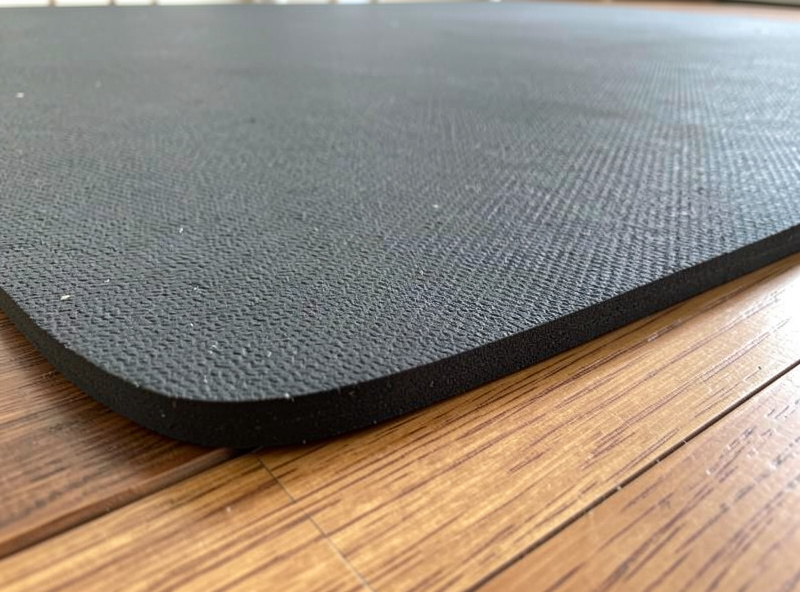
Matching the mat to your floor
The right mat depends on what is under it. Here is how I would choose across the common floor types, reading the load and the risk for each rather than buying one generic mat and hoping.
| Floor type | Main risk | What to use |
|---|---|---|
| Hardwood / engineered | Point-load dents, finish scuffing | Dense rubber mat, full deck footprint |
| Laminate / vinyl | Compression marks, seams lifting | Firm mat with a smooth underside |
| Tile / concrete slab | Mostly noise, little floor risk | Dense mat for vibration, not protection |
| Carpet | Deck instability, heat trapping | Firm mat to stabilize and level the deck |
Carpet is the sleeper problem. A pad placed straight onto thick carpet sits on an unstable, springy base that lets it rock, and the pile can trap motor heat. A firm mat over the carpet gives the deck a flat, solid platform and lets it breathe. On a concrete slab, by contrast, floor damage is barely a concern and the mat is almost entirely about noise and keeping the deck level. Read your own floor before you buy.
The apartment problem
If you live above someone, the vibration path is the whole ballgame, and it is a bigger reason to think twice than any frame spec. Low-frequency footfall energy travels efficiently through a suspended floor and arrives in the unit below as a rhythmic thump that is genuinely annoying — the kind of thing that starts neighbour disputes. This is structure-borne sound, and it is much harder to stop than airborne noise because the building itself carries it.
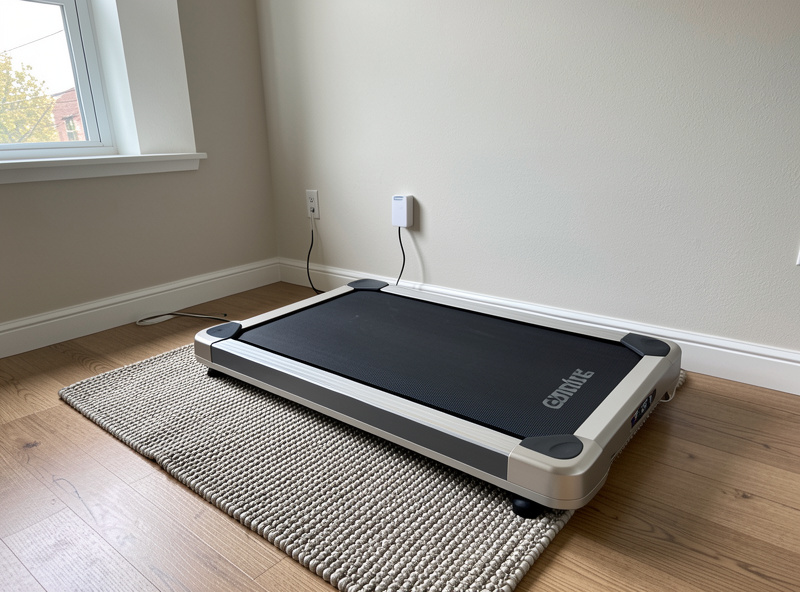
A dense mat is your first and most important defence, and it helps a lot, but be honest about its limits — it reduces the transmitted thump, it does not erase it. Two things compound it: walking slower lands your footfall lighter, and positioning the pad over a load-bearing area near a wall rather than the springy centre of a floor span couples less energy into the structure. If you genuinely cannot lay a proper mat, or the floor is especially lively, that is a fair reason to skip a treadmill desk entirely — the same honest filter I apply to whether the frame can take it. The frame will hold; the question is whether your building wants to broadcast your walk.
Sizing and thickness — get the footprint right
A mat that only covers the deck does half a job. I size the mat to extend a little beyond the deck on all sides — enough that the pad’s feet sit well inside the edges and that any shift as you step on and off still lands on the mat, not the bare floor. An undersized mat lets a foot creep onto the floor edge over time, which is exactly where a dent shows up. Bigger is cheap insurance here; the mat costs a fraction of a refinished floor.
Thickness matters too, but more is not automatically better. A dense rubber mat in the 6-12 mm range is the sweet spot: thick enough to spread the load and damp vibration, thin enough that the deck stays stable and you are not adding unwanted height to an already-raised walking position. Remember the deck plus mat both add to your standing height — so a very thick mat quietly changes your desk math, which is the geometry I cover in the height guide. A firm, moderately thick mat beats a thick, soft one every time; density is doing the work, not raw thickness.
The economics: mat now, or floor later
This is where I would push back on anyone tempted to skip the mat to save money. A good high-density treadmill mat is a modest one-time cost. Refinishing a section of dented, scuffed hardwood is not — it is a real job with real money and a disrupted room, and on a rented apartment it can mean losing a deposit. The mat is the cheapest insurance policy in the whole walking-desk build, and it is the one I would buy before a fancier pad.
The same maths applies to the noise side in an apartment. The cost of a mat is trivial next to the cost of a soured relationship with the neighbour below you, or a building complaint. When I weigh a contact point in any setup, I look at what failure costs, and a bare-floor walking pad fails in two expensive ways at once — the floor and the peace. A dense mat addresses both for the price of a couple of takeaway dinners, which makes it an easy call.
How I set mine up
My own arrangement is deliberately boring, because boring is what lasts. Dense rubber mat laid first, sized a little larger than the deck. Pad centred on it with all four feet well inside the edges and the whole thing checked level so nothing rocks. The pad’s power lead routed off the floor so a foot cannot catch it, managed alongside the desk’s own cabling. Then I walk on it for a minute and watch for any shift before I trust it.
That is the entire ritual, and it takes ten minutes once. After that I clean the belt occasionally, glance under the deck for trapped grit now and then, and otherwise forget about it — which is the goal. The floor layer should disappear from your attention completely; if you are thinking about your mat day to day, something is wrong with the setup, not the mat.
The small stuff that protects the floor too
A few details beyond the mat round out the floor protection. Lift the pad to move it rather than dragging it — dragging grinds whatever grit is on the mat into the surface beneath. Keep the belt clean, because grit tracked onto the belt ends up as abrasive under the deck feet. And check the mat periodically for trapped debris, since a hard particle under a heavy moving deck is exactly how a mat-protected floor still ends up marked.
Footwear plays a quiet role here as well: a clean, soft, flat shoe tracks less grit onto the belt and mat than an outdoor sole, which is one more reason I keep a dedicated pair for the desk — the wider barefoot-versus-shoes question is in shoes versus barefoot at a standing desk. Get the mat right, keep it clean, and the floor under a walking desk will look the same in three years as it does today. If you are still deciding between a slim pad and a fixed unit, the floor-fit trade-offs are in walking pad vs treadmill desk — and whichever you choose, the dense mat underneath is the part I would never skip.
Related Articles
- Treadmill Desk Guide: Pairing a Walking Pad With Your Frame
- Under-Desk Treadmill Noise: What You’ll Actually Hear
- Walking Pad vs Full Treadmill Desk: Which Fits Your Floor
- Will an Under-Desk Treadmill Overload Your Standing Desk?
- Desk Height for Walking: Why the Treadmill Deck Changes It
- Best Under-Desk Treadmills: What I’d Buy at Each Price
