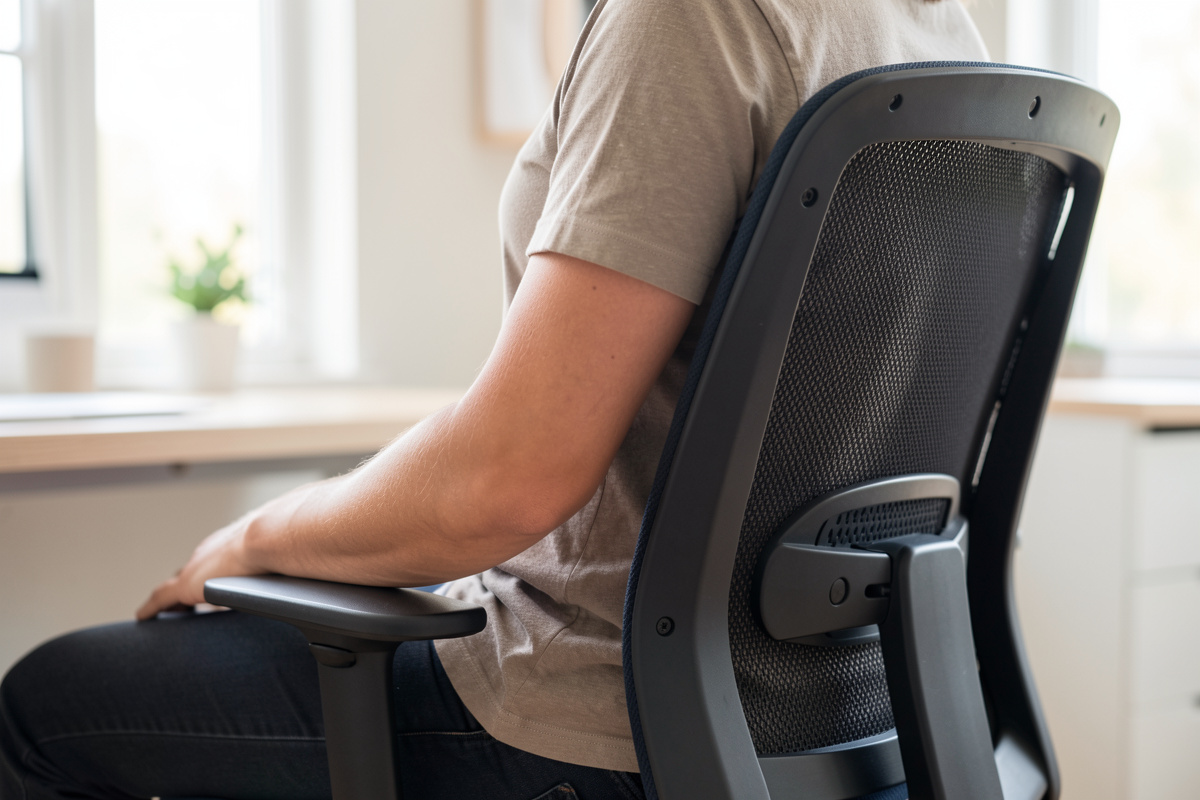

Ergonomic chair lumbar support works when its contact point sits at the inward curve of your lower back, roughly belt height, and when you can move it there. The feature that actually matters is height-adjustable lumbar, not the word “support” printed on the box.
I judge lumbar the same way I judge every dimension on a chair: by whether its range covers my body, not by the marketing. This is a comfort-and-geometry assessment, not a medical one, lumbar contact is about not holding yourself upright with muscle effort over a long day, nothing more. Get the position right and it disappears into the background; get it wrong and you feel it by mid-afternoon.
What Lumbar Support Actually Does
Lumbar support fills the gap between your lower back’s inward curve and the flat plane of the backrest, so the backrest carries some of your upper-body weight instead of your own muscles doing it. The job is contact at the right place, which is a fatigue question, not a health one.
Sit upright and reach behind your lower back: there is a hollow there, the inward curve. Against a flat backrest, that hollow is unsupported, and over hours your muscles quietly do the work of holding you up. A lumbar that fills the hollow lets the chair share that load, which is why a well-positioned lumbar feels like nothing at all, you simply notice you are less tired of sitting by the end of the day. The catch is entirely about position: the support has to land in the hollow. Land it above or below and it either pushes your mid-back forward or does nothing, and a misplaced lumbar can be less comfortable than no lumbar at all. That is the whole ballgame, and it is why I care about adjustment range above everything else.
Why Height-Adjustable Lumbar Is the Feature That Matters
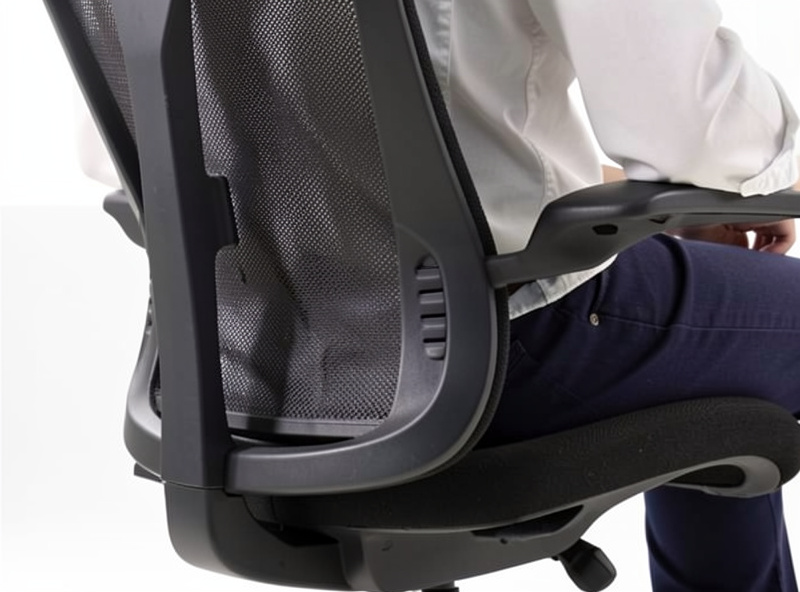
Height-adjustable lumbar lets you move the contact point up or down to land in your lower-back hollow, which differs by torso length from person to person. It is the single lumbar feature worth paying for, because a fixed lumbar only suits whoever the factory designed it around.
People have different torso lengths, so the hollow of the lower back sits at different heights above the seat. A lumbar fixed at one height is a bet that you match the factory’s target, usually someone around average height, and if you do not, there is no fix. When I evaluate a chair I push the lumbar to both extremes of its travel and check whether either end actually lands in my hollow; if neither does, the chair is wrong for me regardless of brand or price. Depth-adjustable lumbar, how far it protrudes, is a nice bonus that tunes the firmness of contact, but height is the one that determines whether the support is in the right place at all. The same range-versus-your-body logic runs through the whole chair fit by body measurements method.
The Common Lumbar Types, Ranked by Usefulness
Lumbar implementations range from a fixed foam bulge at the bottom of the price scale to height-and-depth adjustable systems on contract chairs. The more axes you can adjust, the more bodies the chair fits, which is why the adjustable types are worth the premium.
Here is how the common types compare on the thing that matters, whether you can put the contact where your hollow is.
| Lumbar type | Adjustability | Fits whom | Verdict |
|---|---|---|---|
| Fixed foam bulge | None | Whoever matches the factory height | A gamble outside average builds |
| Built-in contoured backrest | None (shape only) | Average torso lengths | Can work, cannot be corrected |
| Height-adjustable lumbar | Up/down | Most torso lengths | The feature to prioritize |
| Height + depth adjustable | Up/down + protrusion | Widest range of bodies | Best, common on contract chairs |
The pattern is the same as every other chair dimension: fixed implementations gamble on your body matching the factory, adjustable ones let you fit the chair to you. This is exactly the durability-and-adjustability case behind the used premium chair argument, contract chairs almost always have the height-and-depth adjustable lumbar that budget chairs leave out.
Static Lumbar vs Active Lumbar Systems
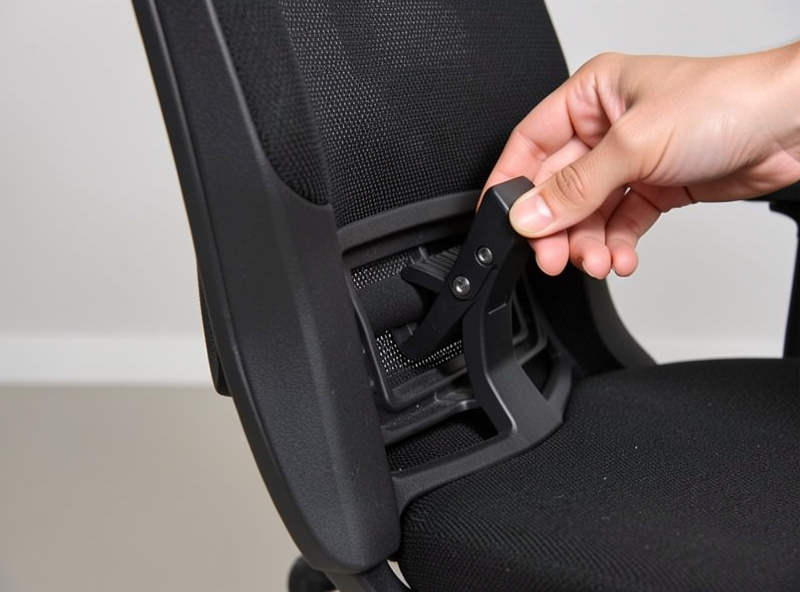
Most lumbar support is static: you set the height once and it stays put. Some contract chairs add an active or self-adjusting backrest that flexes as you move, aiming to keep contact through reclines. Both can work; the static type is simpler and easier to get right, while active systems trade a little predictability for movement.
I lean toward a well-set static lumbar because it does exactly one thing and does it where I put it. You sit back, the contact lands in your hollow, and it stays there whether you are leaning into focused work or sitting upright. Active systems, the ones that pivot or tension the lumbar as you recline, are clever and some people love how they track movement, but they add a variable: the contact point moves, and if the mechanism is tuned wrong for your build, it can drift out of your hollow exactly when you relax back. On a contract chair with a good active system the tracking is genuinely nice; on a cheaper imitation it is just unpredictable. When in doubt, a height-adjustable static lumbar you can dial in and forget is the safer pick, and it is what I run on my own chairs. The fancier the mechanism, the more it depends on the manufacturer having engineered it properly, which loops back to why tier matters across every part of a chair.
How to Set Your Lumbar Correctly
Sit all the way back against the backrest with your seat depth already fitted, then raise or lower the lumbar until its contact lands in the hollow of your lower back at roughly belt height. You should feel even contact through the curve, not a single pressing point.
Fit the seat depth first, because if you are perched forward off a too-deep seat you are not even touching the lumbar, and no lumbar setting can help. Once you are properly back, adjust the lumbar height in small steps and pay attention to where the contact falls: too high and it pushes your mid-back, too low and it presses your tailbone area, just right and it fills the hollow with even, gentle contact. If your chair has depth adjustment, dial the protrusion so the contact is firm enough to share the load but not so firm it forces you forward. Then write the setting down, the same way I log every chair setting, so you can restore it after anyone else adjusts the chair. The order, seat depth then lumbar, matters, which is why I treat lumbar as one step inside the full ergonomic chair guide rather than a standalone fix.
What Lumbar Support Cannot Do
Lumbar support is about comfortable seated positioning and load-sharing over a long day; it is not a treatment, a corrector, or a remedy for anything, and any product that promises more than comfort is overselling. Keep your expectations to what the geometry actually delivers.
I am deliberate about this line because the chair industry blurs it constantly. A well-fitted lumbar makes a long working day more comfortable by letting the backrest carry some load, and that is the entire claim, full stop. It does not fix, prevent, or treat anything, and I am not the person to ask about that, those are questions for a qualified professional, not a desk-gear publisher. What I can tell you is the geometry: contact in the hollow, height adjustable to your torso, set after the seat depth. Treat lumbar as one more dimension to fit to your body, judged by range and position, and it does its modest, real job well. Expect it to be more than that and you will be disappointed by physics, not by the chair.
Do Add-On Lumbar Cushions Work?
A strap-on lumbar cushion can help on a chair that has a usable seat but a flat or badly-placed backrest, because it adds contact where the chair offers none. It cannot fix a chair whose seat depth is wrong, since a too-deep seat keeps you perched forward off the backrest entirely, cushion or not.
I have tried the aftermarket cushions, and my honest verdict is that they are a patch, useful in a narrow case and useless outside it. The case where they help: a chair that fits your seat depth so you actually sit back, but whose backrest is flat or whose fixed lumbar lands wrong. There, a cushion you can position by hand effectively becomes your adjustable lumbar, and it is a cheap save. The case where they do nothing: any chair you perch forward on because the seat is too deep, because you are not touching the backrest in the first place, so adding padding to it changes nothing. People reach for a cushion hoping it fixes a chair that is fundamentally the wrong size, and it cannot, geometry is geometry. So before buying a cushion, confirm your seat depth is right; if it is, a cushion is a reasonable patch, and if it is not, the cushion is money toward the wrong problem and a different chair is the answer.
