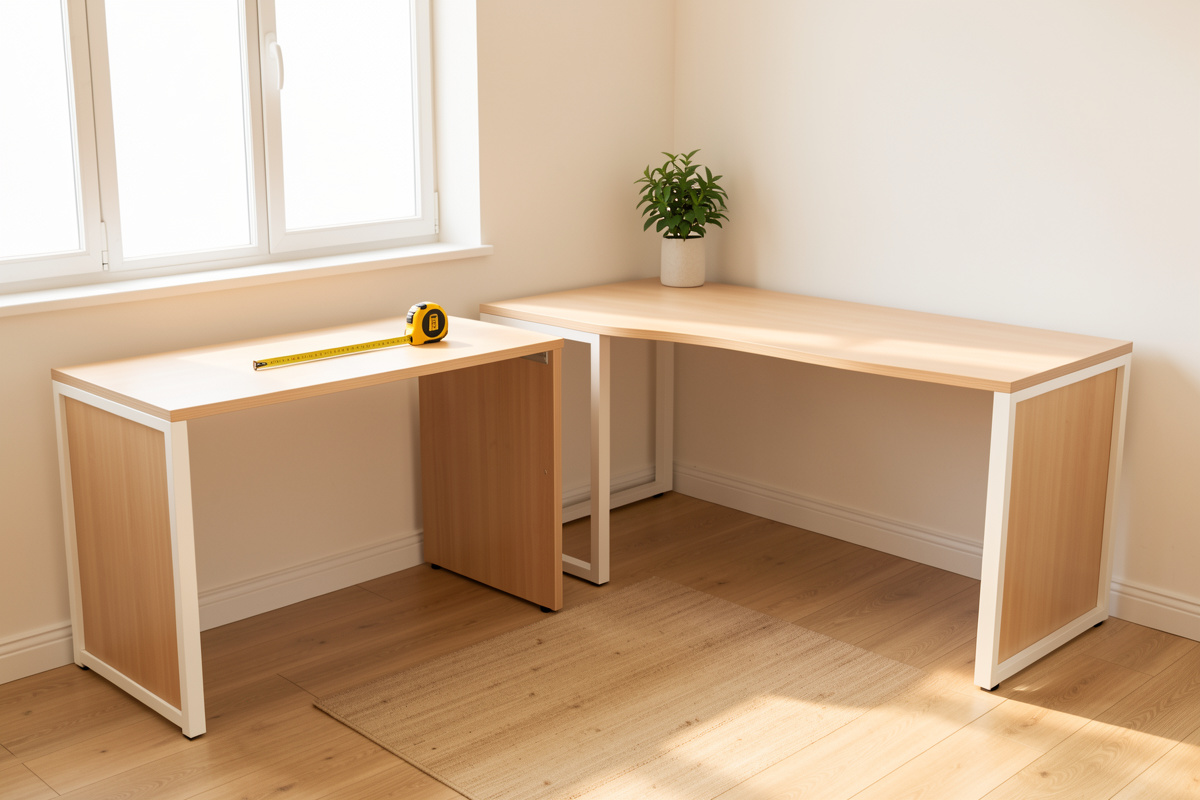

The best compact desk for a small space is the one whose real dimensions fit your room and your body — not the one with the highest star rating. In my setup log the numbers that decide it are width (80–110 cm for a usable single-monitor desk), depth (50 cm minimum if you add a monitor arm), and knee clearance under any drawer. Get those three right and almost any well-built desk works; get them wrong and the prettiest desk becomes a regret.
I have assembled, lived with, and returned more desks than I would like to admit, and the pattern is always the same: people buy compact desks on looks and listed width, then discover the depth is too shallow for their screen or the drawer apron clips their knees. This guide is the dimension-first way to shop, the desk shapes that actually earn their footprint in a small room, and where a few honest dollars matter. It pairs with the broader small-space desk setup guide if you are still deciding on the whole room.
Shop the Dimensions, Not the Marketing
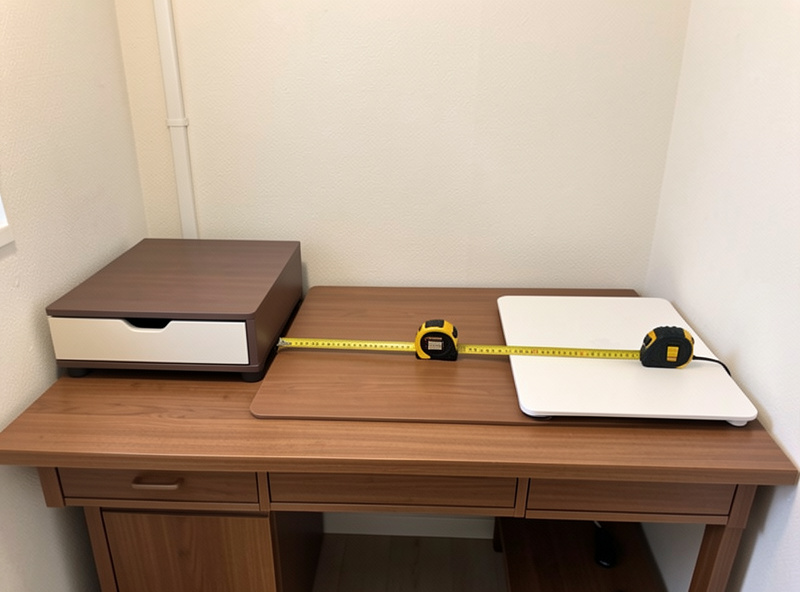
A compact desk lives or dies on four measurements, and product pages bury most of them. Width tells you mouse room. Depth tells you whether a monitor fits at a real viewing distance. Apron-to-floor height tells you whether your thighs clear the underside. Leg-to-leg span tells you whether your chair fits between them. Width is the only one most listings shout about — the other three are where the disappointment hides.
Here is the method I use. Measure your slot, then subtract: chair clearance behind, a few centimetres each side for cables, and the depth your monitor eats on its stock stand. Whatever desk depth survives that subtraction is your minimum. For most people a 50 cm deep compact desk only works once the monitor moves onto an arm — the small-desk monitor arm guide covers that hand-off. Without an arm, you want 60 cm of depth to keep a 24-inch screen at a comfortable distance, and a compact desk rarely gives you that.
Height matters more than buyers expect, too. Most fixed desks ship at 73–75 cm, which is too tall for a lot of people. If your measured elbow height lands lower, you are choosing between a too-high desk and a sit-stand frame. The free way to know your number is the elbow rule, and if you are stuck with a fixed desk that runs tall, the desk-too-high fixes still apply.
The Compact Desk Shapes Worth Considering
Small-space buyers really choose between five shapes, and each suits a different room constraint. The table below is how I rank them by what they cost you in floor space versus what they give back in usable surface. Footprint figures are typical retail ranges — measure your own room against them rather than trusting the listing.
| Desk shape | Typical size | Surface you get | Best when |
|---|---|---|---|
| Compact straight desk | 80–100 cm wide, 50–60 cm deep | Single or tight dual monitor | You have a clean wall slot |
| Sit-stand compact frame | 100 cm wide, height-adjustable | Sit and stand in one footprint | You want two zones, one piece |
| Corner / L-shape | ~120×120 cm | Generous, wraps two walls | A dead corner is your free space |
| Wall-mounted fold-down | 60–90 cm, folds flat | Minimal, disappears | The floor must clear daily |
| Ladder / leaning desk | 60–75 cm wide | Small, with shelves above | You need vertical storage too |
If your room has a usable corner, do not dismiss it — an L-shape often gives more surface per floor area than a straight desk, and I weigh the trade in the corner desk vs straight desk comparison. If the floor has to clear every evening, the fold-down desk is the only shape that truly vanishes. And if the desk has to hide entirely, that is a cloffice question, not a desk-shape one.
Build Quality on a Compact Desk: What Actually Matters
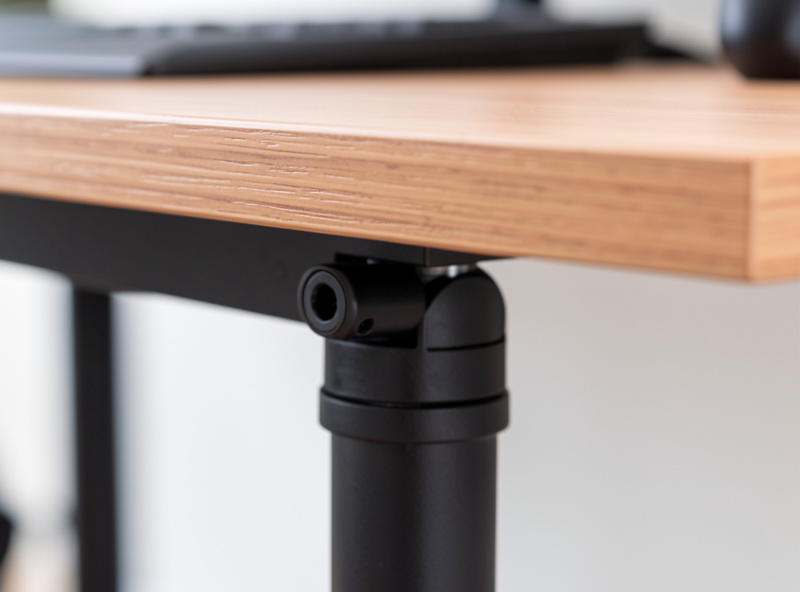
On a small desk, structural quality shows up faster than on a big one because there is less mass to dampen movement. The two things I check before anything else are the leg-to-top joint and the top material. A particleboard top with a thin laminate is fine for light use, but a compact desk that will carry a monitor arm needs a top thick and solid enough for the clamp to bite — the clamp and grommet reality guide explains why a hollow or sub-18 mm top is a problem.
Wobble is the other tell. A four-leg compact desk with no cross-brace will rack side to side, and on a narrow footprint that movement is amplified. If you can, push the desk diagonally in the showroom or read assembly reviews for the word “wobble” specifically. A sit-stand compact frame solves this differently — a good dual-motor frame is stiffer at sitting height than most fixed compact desks, and the trade-offs are in the dual vs single motor breakdown.
What I Would Buy, and In What Order
If the room is a fixed wall slot and your elbow height matches a standard desk, a solid compact straight desk is the cheapest path to a clean setup — spend the saved money on a monitor arm instead of a fancier top. If two people share the room or your elbow height runs low, a compact sit-stand frame earns its premium by giving you the height range and a second standing zone in the same footprint. If you have a dead corner, the L-shape is the surface-per-floor winner.
I will not pretend to have bench-tested every model on the market, so I shop by category and dimension rather than by brand worship. Browsing a compact desk search filtered to your measured width, or a small standing desk around 100 cm, gets you to the right shortlist faster than any “best of” list that ignores your room. As an Amazon Associate I earn from qualifying purchases.
Whatever you pick, treat the first week as a trial. Measure your geometry after assembly, sit at it for real working days, and keep the box until you are sure. The compact desks people keep are the ones that fit a measurement, not a mood.
Frequently Asked Questions
What size desk is best for a small space?
For a single monitor, aim for 80-100 cm wide and at least 50 cm deep, paired with a monitor arm to reclaim depth. Without an arm you want 60 cm of depth so a 24-inch screen sits at a comfortable distance. Width is forgiving; depth is the number that limits you.
Is a standing desk worth it in a small room?
Often yes, because a sit-stand frame gives you both a sitting and a standing zone in one footprint instead of two pieces of furniture. A good compact dual-motor frame is also stiffer at sitting height than many cheap fixed desks. The cost is the higher price and a heavier assembly.
Are corner desks good for small bedrooms?
A corner desk converts an otherwise dead corner into generous surface and often gives more usable area per floor space than a straight desk. The trade-off is that it occupies two walls and is harder to clamp a monitor arm to cleanly. It suits dual-monitor users with a spare corner.
How deep does a compact desk need to be?
At least 50 cm if you mount the monitor on an arm, or 60 cm if the screen sits on its stock stand. A 45 cm deep desk forces a large monitor too close and pushes your keyboard to the front edge, which is the most common small-desk regret.
Can a cheap compact desk hold a monitor arm?
Only if the top is solid and thick enough for the clamp to bite, generally 18 mm or more of real material, not a hollow core. Many budget compact desks have thin or hollow tops that flex or crush under a clamp. Check the top thickness before assuming an arm will mount.
